AI in Schools: Compliance Checklist (EU AI Act)
Helping Schools Choose Safe, Ethical, and Effective AI Tools
Artificial Intelligence (AI) is rapidly transforming education, offering new ways to enhance learning and streamline school administration. However, not all AI tools are designed with students in mind. Schools must ensure that AI is used responsibly, ethically, and in compliance with the EU AI Act and GDPR.
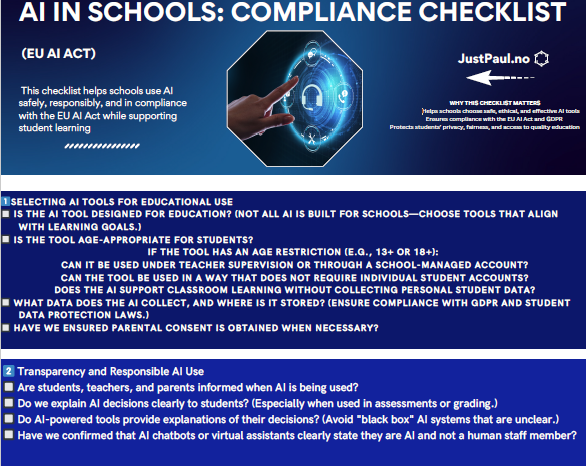
This AI in Schools Compliance Checklist is designed to help educational institutions assess and implement AI tools while prioritizing student privacy, fairness, and access to quality education.
Why This Checklist Matters
AI can be a powerful ally in education, but it also comes with risks. Schools must ensure that AI enhances learning without compromising student data, transparency, or fairness. This checklist helps schools:
- Comply with EU AI and data protection regulations
- Select AI tools that align with educational needs
- Ensure responsible and ethical AI use in the classroom
- Provide transparency to students, teachers, and parents
By following these guidelines, schools can confidently integrate AI into education while ensuring student safety and compliance with legal standards.
1. Selecting AI Tools for Educational Use
Not all AI is built for education. Schools must carefully evaluate AI tools before implementation. Consider the following:
- Educational Purpose: Is the AI tool specifically designed for schools and learning environments?
- Age Appropriateness: Does the tool meet the age requirements of students? If it has an age restriction (e.g., 13+ or 18+), can it be used under teacher supervision or with a school-managed account?
- Data Collection: What student data does the AI tool collect, and where is it stored? Does it comply with GDPR and student data protection laws?
- Parental Consent: Have parents been informed and given consent where necessary?
Selecting AI responsibly ensures that it supports learning without compromising student privacy or safety.
2. Transparency and Responsible AI Use
AI should enhance, not replace, human decision-making in education. Transparency is essential for trust and accountability. Schools should ensure:
- Students, teachers, and parents are informed when AI is being used.
- AI-powered tools provide clear explanations for their decisions.
- No “black box” AI systems are used—AI decisions should be understandable and explainable.
- AI chatbots or virtual assistants clearly state that they are AI and not human staff members.
By maintaining transparency, schools build trust and empower students to engage critically with AI.
3. AI in Teaching, Learning, and Assessment
AI can be a valuable tool in education, but it must be used to support teachers, not replace them. Schools should ensure that:
- AI assists with learning while keeping teachers at the center of decision-making.
- AI-powered grading and feedback tools are reviewed for fairness and accuracy.
- Students and parents have the ability to challenge or appeal AI-generated results.
- AI-generated content is checked for bias to prevent discrimination in learning materials.
AI should serve as a supportive tool that enhances education while maintaining fairness and integrity.
4. Data Protection and Privacy Compliance
AI tools in schools must adhere to strict data protection laws, including the GDPR. To protect student privacy, schools should verify that:
- AI tools comply with EU data regulations and do not collect unnecessary personal data.
- Student data is anonymized or stored securely.
- AI systems do not retain student information longer than necessary.
- Schools have clear policies on how AI interacts with student data.
By prioritizing data privacy, schools can ensure that AI enhances learning without putting students at risk.
5. AI in School Administration
AI is increasingly used in school administration for admissions, attendance tracking, and behavior management. However, human oversight is essential to prevent bias or unfair decision-making. Schools should ensure:
- AI-driven decisions (e.g., admissions or academic support) always involve human review.
- AI systems are tested for bias that could negatively impact students.
- Records of AI decisions are maintained for accountability and transparency.
AI should simplify administrative tasks while ensuring fairness and inclusivity in school policies.
6. AI Training and Digital Literacy
As AI becomes more prevalent, schools must equip students and teachers with AI literacy skills. This includes:
- Providing professional development for teachers on AI integration.
- Educating students on how AI works, its limitations, and potential biases.
- Encouraging critical thinking when interacting with AI-generated content.
By fostering AI awareness, schools prepare students for a world where AI is a fundamental part of daily life.
7. Ongoing AI Monitoring and Compliance
AI compliance is an ongoing process. Schools must regularly review and update their AI policies to keep up with evolving regulations. Key steps include:
- Conducting annual reviews of AI tools to ensure they remain compliant.
- Providing a reporting system for students, teachers, and parents to raise AI-related concerns.
- Staying informed about updates to the EU AI Act and adjusting policies accordingly.
A proactive approach to AI compliance ensures that schools continue to use AI safely and ethically.
Download the Full Compliance Checklist
To help schools implement these best practices, we’ve created a comprehensive AI in Schools Compliance Checklist.