
Command Terms and Bloom’s Taxonomy: Building a Common Language for Deeper Learning
In the International Baccalaureate (IB) framework, command terms play a crucial role in shaping the way students understand and approach tasks across disciplines. Aligned with Bloom’s Taxonomy, these terms provide a structured progression of cognitive skills that support students’ development from foundational knowledge to higher-order thinking. When introduced consistently from early years, command terms empower students to engage with academic challenges confidently and prepare them for the rigorous expectations of the Diploma Programme (DP).
Command terms like “describe,” “analyze,” and “evaluate” are more than instructions; they establish a common language that unifies learning expectations across all grade levels. When students understand what each term demands—whether recalling information or critiquing complex ideas—they approach tasks with greater clarity and purpose. This shared language not only fosters consistency but also helps students internalize cognitive processes, making learning more intentional and effective.
Bloom’s Taxonomy: A Foundation for Cognitive Growth
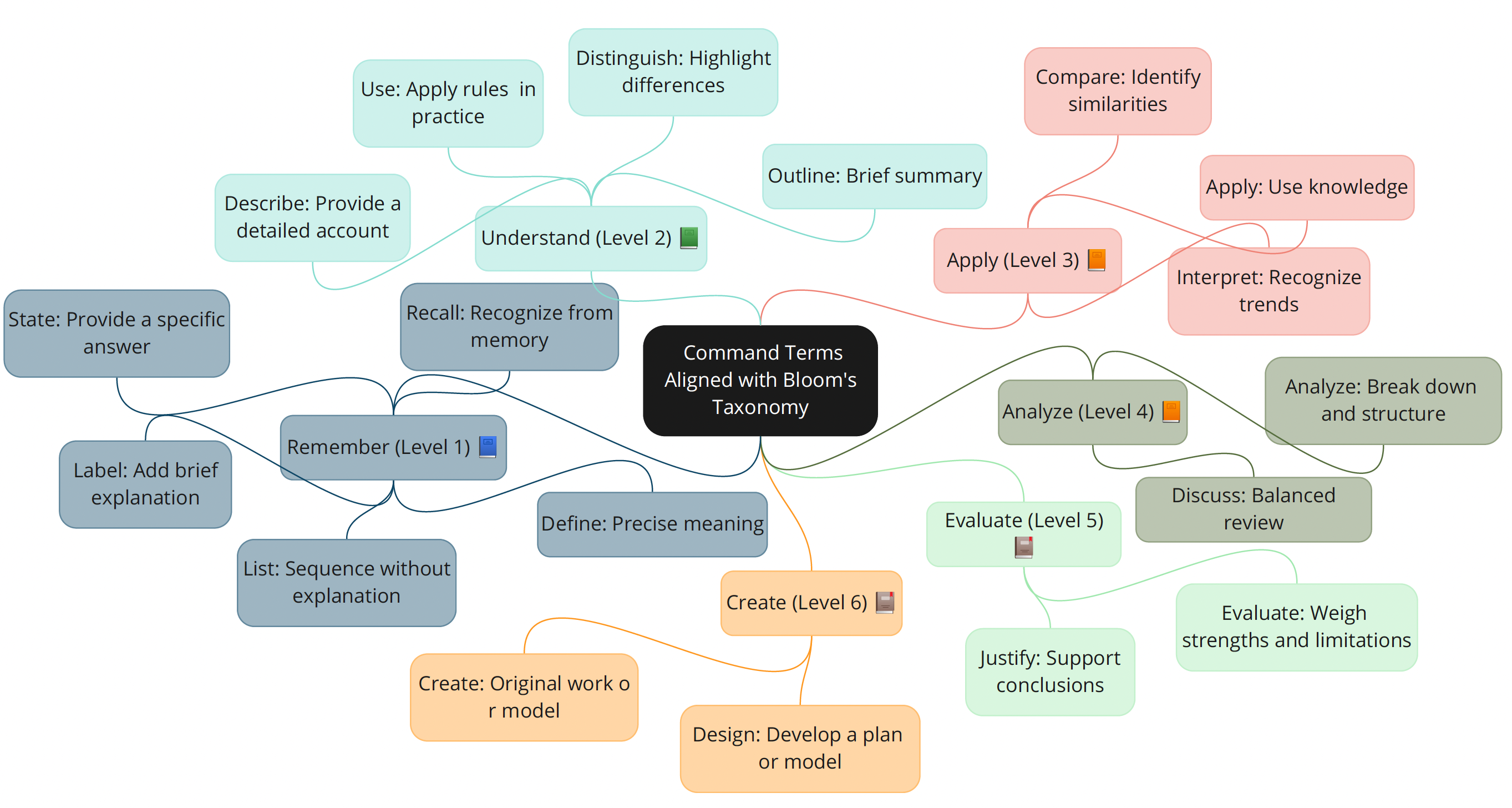
Bloom’s Taxonomy categorizes cognitive skills into levels, from remembering and understanding to applying, analyzing, evaluating, and creating. By aligning IB command terms with Bloom’s levels, we provide a roadmap for intellectual development. Students start by mastering basic tasks such as defining and listing, then progress to analyzing, evaluating, and creating—essential skills for both academic and real-world success.
Creating Lifelong Learners with Command Terms and Bloom’s Levels
Through repeated exposure to command terms at each level of Bloom’s Taxonomy, students gradually build their critical thinking skills. This approach not only prepares them for exams but also instills a mindset of inquiry, adaptability, and self-reflection. When students understand the progression from “state” to “justify” or from “outline” to “design,” they see learning as an evolving journey where each skill builds upon the last.
Supporting a Diverse Range of Learners
Using command terms school-wide supports differentiated instruction by clearly defining expectations. For example, tasks that ask students to “describe” or “list” may be accessible entry points, while “evaluate” or “synthesize” challenge advanced learners to stretch their thinking. This approach helps educators tailor instruction to meet the needs of all students, ensuring that everyone can engage meaningfully with the material.
A Unified Language for Academic and Personal Growth
Ultimately, integrating command terms and Bloom’s levels throughout the school cultivates a culture of academic rigor, critical thinking, and personal growth.
Students learn to take ownership of their cognitive journey, becoming not only skilled learners but also adaptable, reflective individuals prepared to thrive in a complex world.
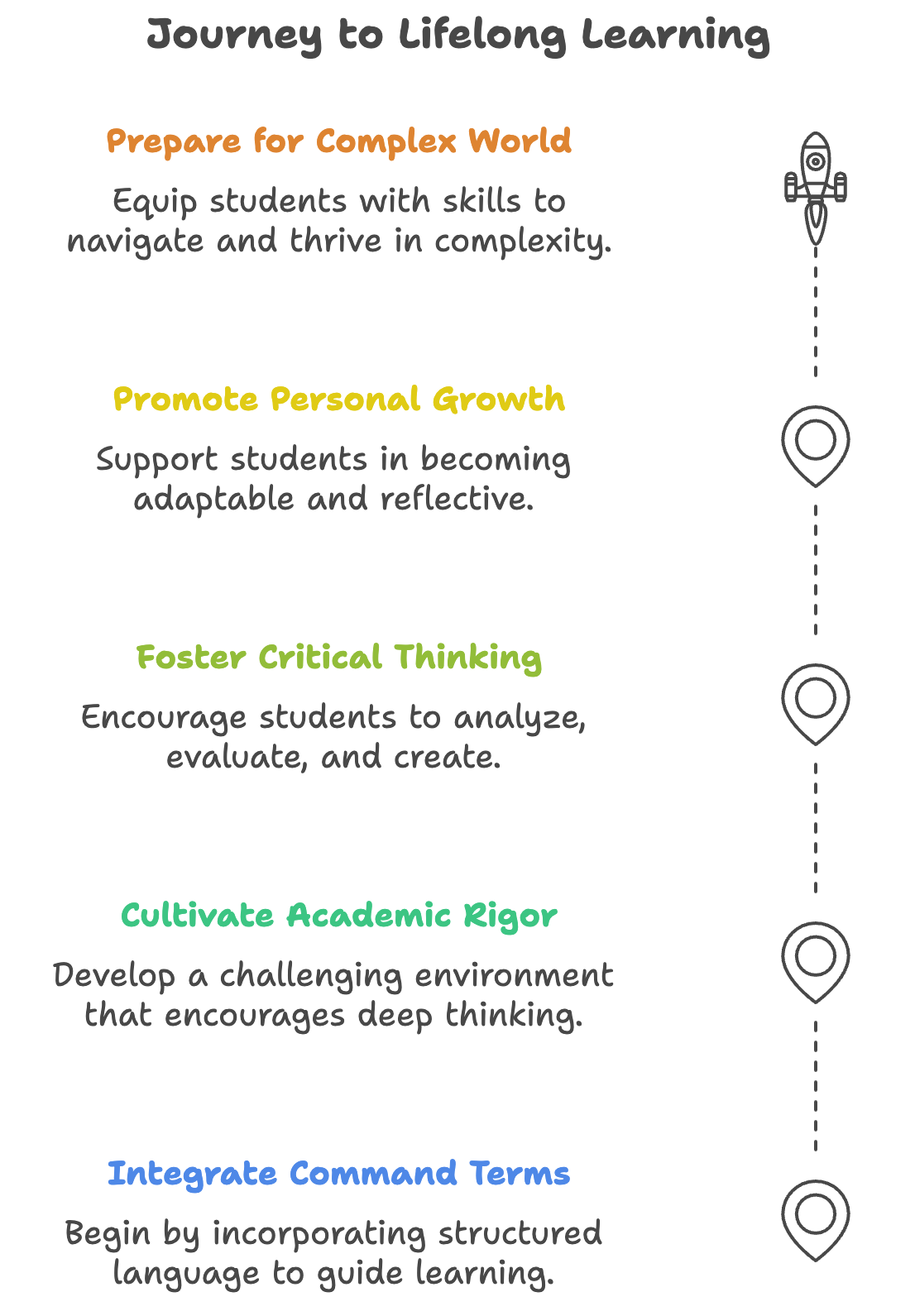
By reinforcing this language at every grade level, we give students the tools they need to navigate academic challenges and make meaningful connections across subjects—building a foundation for lifelong learning and success.
Practical Ways to Embed Command Terms and Bloom’s Taxonomy in Lessons
Understanding and applying IB command terms, aligned with Bloom’s Taxonomy, can empower students at every stage of their educational journey. Here are some practical activities that teachers can integrate into their lessons to help students build familiarity with these terms and the cognitive skills they represent. These ideas offer engaging ways for students to practice and internalize command terms, creating a consistent language that will support them in every subject.
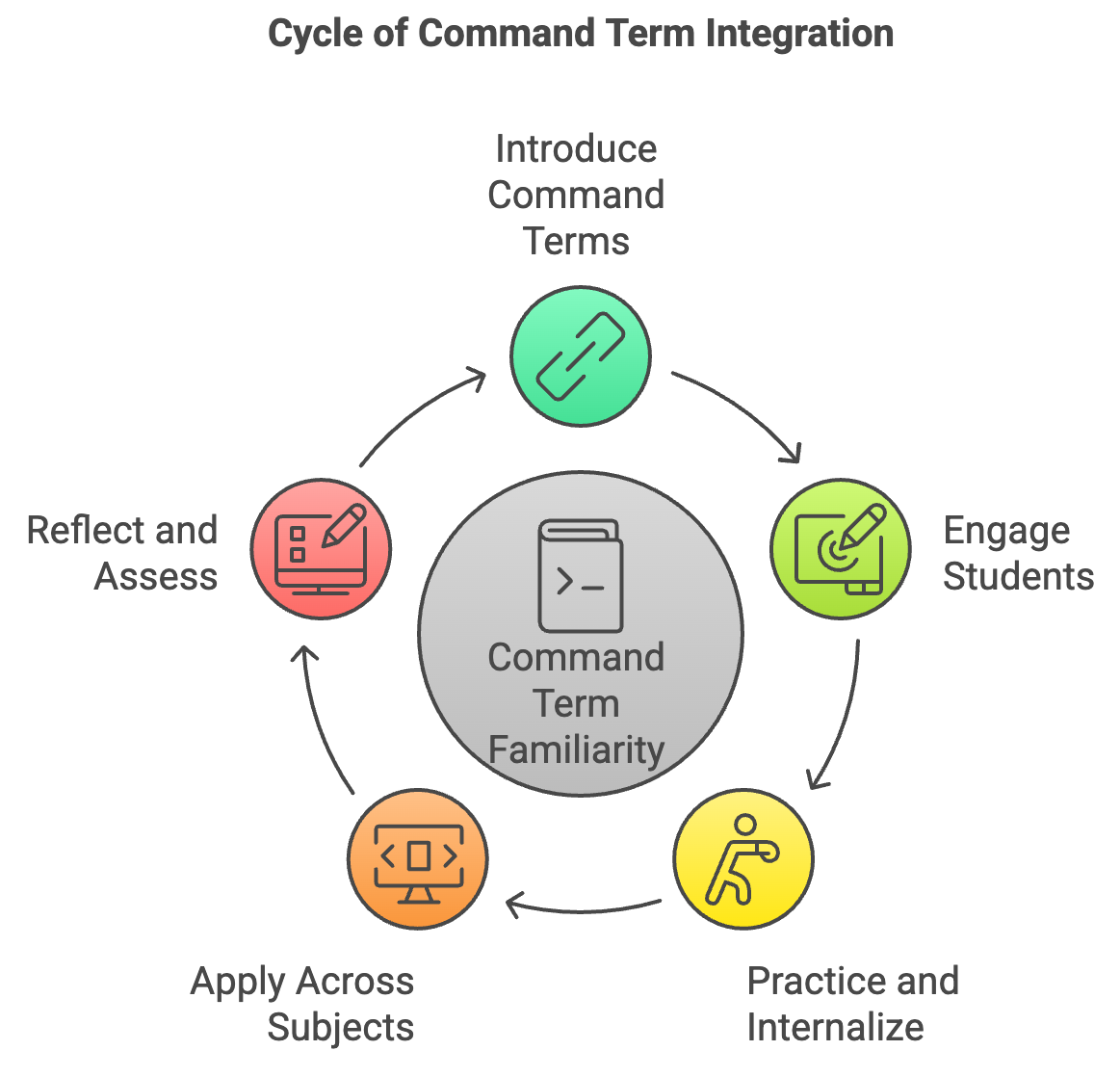
1. Command Term Walls
Create a “Command Term Wall” in the classroom that displays key command terms grouped by Bloom’s levels (e.g., “Remember,” “Understand,” “Analyze”). During each lesson, encourage students to select a term from the wall and explain how it relates to the topic at hand. This approach reinforces familiarity with each term’s expectations.
2. Question Stems Using Command Terms
Develop question stems using command terms at various Bloom’s levels. For example, in a history class, one group could explore “compare” by examining two historical events, while another discusses “evaluate” in the context of an important decision. Providing question stems helps guide students’ thinking and fosters differentiation in cognitive skills.
3. Command Term Reflection Journal
Encourage students to keep a journal to reflect on how they’ve used different command terms in each subject. At the end of the week, students can reflect on how terms like “analyze” or “apply” deepened their understanding of a topic. This practice builds metacognitive awareness as students observe how different cognitive skills impact their learning.
4. Bloom’s Bingo
Create bingo cards featuring command terms linked to Bloom’s levels. As students complete tasks or answer questions using these terms, they can mark off the corresponding box. This turns learning into an interactive game, helping students recognize command terms in various contexts.
5. Command Term Task Cards
Prepare task cards with activities based on different command terms and Bloom’s levels (e.g., “Explain a concept,” “Design a solution”). Distribute these in small groups or as individual tasks. In a science lesson, for instance, students could use a card asking them to “compare” two renewable energy sources or “design” an experiment.
6. Exit Tickets Using Command Terms
Use exit tickets at the end of each lesson to prompt students to respond using a specific command term. For example, “Summarize today’s lesson” or “Justify how today’s math formula could be used in real life.” These quick prompts reinforce the daily application of command terms.
7. Peer Teaching with Command Terms
Assign students to teach a concept to their peers using a particular command term. One student might “demonstrate” a math concept by working through an example, while another might “explain” it in their own words. This activity builds confidence and deepens understanding by making students the instructors.
8. Command Term Dice
Create dice with different command terms. One die could focus on lower Bloom’s levels (e.g., “List,” “Define”) and another on higher levels (e.g., “Evaluate,” “Create”). At the start of the lesson, have a student roll the dice to determine the cognitive skill they will focus on during the class. This makes learning interactive and encourages cognitive versatility.
9. Role Play with Command Terms
Assign students or groups a command term and ask them to act out that term’s meaning within the context of the lesson. For example, in a literature class, one group might “evaluate” a character’s choices, while another “compares” two characters’ motivations. Role-playing brings a lively, hands-on element to cognitive learning.
10. Weekly Command Term Spotlight
Choose one command term to focus on each week. Use this term consistently in all classroom activities, allowing students to explore it across multiple subjects and contexts. By the end of the week, they will have a thorough understanding of how to “justify,” “analyze,” or “design,” developing these skills more naturally.
By incorporating these activities into my lessons, I found that it made command terms an integral part of my students’ learning experience.
These strategies provide consistent practice, making command terms and Bloom’s levels an intuitive part of how my students approach their academic and real-world challenges.
This approach empowers students with the skills to think critically, communicate effectively, and tackle complex problems, laying the foundation for lifelong learning.